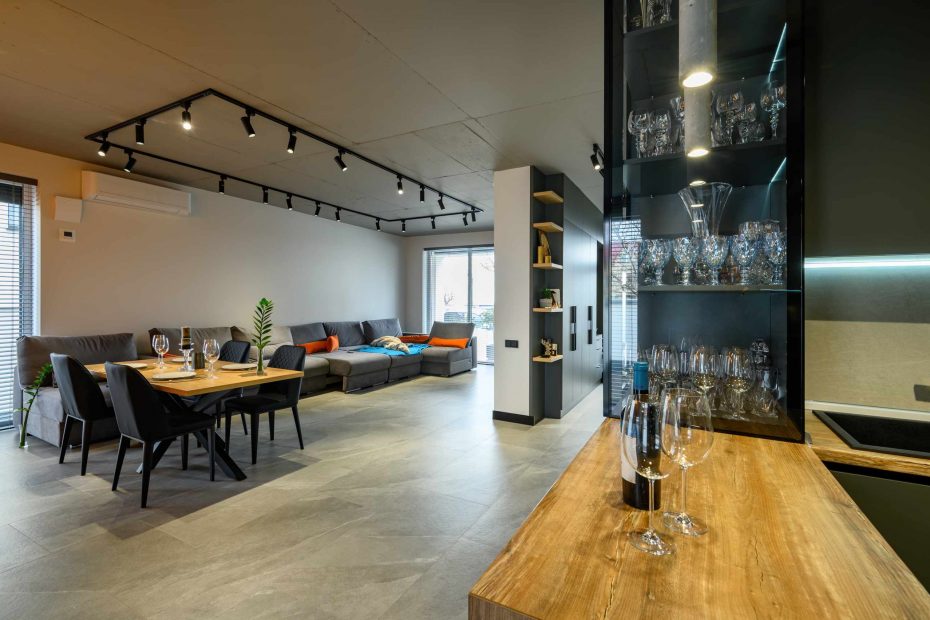
Vertical lines like door frames, cabinet sides, bookcases, walls and window frames will all signal to the viewer how a stable interior photo feels. If your vertical lines look like they’re tilting towards the left or right, the room may appear unstable no matter how beautiful the furniture, lighting and decor happen to be. This can be a reason why a photo feels a little off, even before you can put your finger on what it is. The space isn’t just being shown, it’s being supported by vertical lines.
Here’s a helpful practice: Take two photos of the same wall or doorway. Do the first shot quickly without turning on your grid. Do the second with the grid on, making sure the phone or camera is adjusted so the most prominent vertical line appears straighter. Check the two side by side, and while the second won’t make a huge difference, it will look more calming and the door will look less like it’s leaning backwards, and the wall will look more plausible.
Vertical lines are often affected by the angle at which your camera is looking up or down. If you’re looking up to capture a tall bookcase, for instance, the sides may tilt inward. Looking down from a higher position can make tables and chairs seem squashed and can cause cabinets to lean sideways. Whenever possible, move back and lower or raise your camera position, and try to keep the camera facing more forward than up or down.
It’s not just a technical adjustment. Using your grid to help you see the room you’re about to shoot is also a great way to make it look better before you even take the shot. Pick out one key vertical line closest to the centre, a door frame, cabinet side or wall corner, for example, and make sure that’s looking straighter, then check for lines along the edges of the photo. Wide angles or phone camera modes can distort things, so a table lamp or chair on the edge, may appear curved even if the centre looks true. Shifting the camera will sometimes achieve more than heavy editing.
Of course, it’s often impossible to get every line in frame straight. Rooms will have walls that aren’t perfectly level, older or warped doors, angled furniture, drapes that hang naturally, reflections in mirrors that make objects appear as a strange angle, and it’s unrealistic to ask beginners to produce an architectural drawing out of every interior shot. The best approach is to find the most prominent vertical lines and make sure they are at least close to straight so viewers are able to take in the angle of the room, lighting coming in the window, placement of the furniture and detail in the decor without being distracted by lines that are not straight.
Next time you’re shooting in a room, do a quick frame check before taking the shot. Look at the door frame, shelves, cabinet, pictures and corner of the wall. See if you’ve tilted the camera, or if you’re standing too close to the scene using a wide angle. Look at the image and see if the scene still feels authentic without the key vertical lines drawing too much attention. Even before editing can get in, interior photography will look much better after making that adjustment.